
Tag Archive for: Latest News
Homeowners Seeking Septic System Improvements Have a Flexible Financing Option from Connecticut Green Bank
Successful energy-loan program expands into resilience improvements for homes across Connecticut
HARTFORD, Conn. (March 3, 2026) – The Connecticut Green Bank is pleased to announce a new resource for homeowners facing costly or unexpected septic system repairs or replacement. Through partnerships with participating community banks and credit unions and a network of local contractors, the Green Bank’s Smart-E loan can provide flexible, low-interest financing to help cover these expenses.
“At Drainage Experts LLC, we see firsthand how unexpected septic and drainage issues can place a significant financial burden and stress on homeowners. Partnering with Connecticut Green Bank has allowed us to offer our customers a practical financing option that makes necessary infrastructure repairs and improvements more accessible and less stressful,” said Benjamin Bahler, Managing Member of Drainage Experts, LLC, in Ellington. “Their program gives homeowners the flexibility to move forward with important projects without compromising quality or delaying work that protects their property and the environment.”
The Smart-E loan offers financing up to $50,000 with terms ranging from 5 to 15 years, and competitive interest rates that are not based on borrowers’ credit scores (a minimum credit score applies). To be eligible for Smart-E, the home must be owner-occupied with 1-4 units, and the homeowner must meet debt-to-income ratio requirements.
“From a contractor’s perspective, the Connecticut Green Bank team has been professional, responsive, and easy to work with throughout the process,” continued Bahler. “The application and approval experience has been straightforward for our customers, and the clear communication helps ensure everyone understands the scope, timeline, and financing details. Having a trusted financing partner not only supports homeowners but also helps us deliver long-term solutions with confidence. Overall, the program has been a valuable resource for our customers and our business. It allows homeowners to invest in reliable septic and drainage systems while supporting responsible environmental practices. Definitely a win for the homeowner, the contractor, and the community.”
In addition to Drainage Experts, ALT Services LLC in Hamden, Brookfield Septic Service, Inc., in Brookfield, Camarota Sanitation & Excavation in Durham, CT Septic and Inspections LLC in East Haddam, Downies Septic and Excavation LLC in Old Saybrook, New London County Septic Service Inc., in Ledyard, and T & A Mechanical LLC in Brooklyn are also currently offering the Smart-E loan to homeowners seeking financing for septic projects. Any septic contractor in the state can easily become eligible to offer Smart-E. Contractors are encouraged to contact the Green Bank to learn more about the process.
“A working septic system is a non-negotiable item for homeowners, so when upgrades or improvements are needed, we are excited to offer Smart-E as a lending solution to address this important need,” said Barbara Waters, Director of the Smart-E loan program. “This type of project can create financial challenges, but with Smart-E, homeowners have a flexible option to pay to get their system running properly again.”
Since 2013, the Smart-E loan has helped homeowners make energy-related improvements, including adding solar and battery storage, upgrading HVAC systems, and adding insulation. The program was recently expanded to include resiliency-related projects, such as septic systems, wells, basement floodproofing, and lead pipe replacement, to encourage homeowners to make their properties more climate-ready. Properly functioning septic systems can help prevent groundwater and surface water contamination, as well as other public health issues.
In total, more than 300 contractors provide Smart-E to their customers annually, and more than 10,000 homeowners have benefited from the loans.
For more information about Smart-E, please visit https://www.ctgreenbank.com/smarte.
Lynch Toyota in Manchester Goes Solar Using C‑PACE Financing
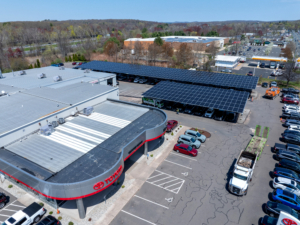
Photo courtesy of Earthlight Technologies
Family-owned dealership installs solar carport projected to save nearly $1 million in energy costs
HARTFORD, Conn (February 17, 2026) – The Connecticut Green Bank and Lynch Toyota in Manchester are proud to announce the completion of a solar carport installation at the dealership financed through C-PACE. The 298.1 kW solar carport installed by Earthlight Technologies in Ellington is projected to save more than $968,000 over its lifetime.
Lynch Toyota in Manchester is a family-owned and operated car dealership founded in 1970 by Michael B. Lynch Sr. The dealership offers a wide selection of new and used cars, trucks, and SUVs, along with an autobody shop and a full-service department. Since 2003, Lynch Toyota has received Toyota’s President’s Award every year, recognizing excellence in customer satisfaction and operational performance.
“For us, covering our lot with solar panels makes both financial and practical sense. We are saving money, and it helps keep our vehicles protected from the elements,” said General Manager Conor Lynch.
Solar projects financed through Commercial Property Assessed Clean Energy (C‑PACE) are designed to achieve a positive savings-to-investment ratio, meaning energy savings are expected to exceed project costs over time, helping commercial property owners reduce operating expenses while investing in clean energy upgrades.
“A solar canopy can be a great option for a property owner wanting the benefits of solar when the roof isn’t the right choice and a large parking lot is available,” said Mackey Dykes, Vice President of Financing Programs at the Green Bank. “The best approach for property owners is to discuss their specific needs with a contractor and learn what makes the most sense for their situation.”
Since its inception in 2013, the C-PACE program has supported more than 429 projects and enabled more than $400 million in investment, allowing commercial property owners to focus on their businesses and reduce their energy costs.
To learn more about C-PACE, please visit www.ctgreenbank.com/c-pace/.
Connecticut’s Energy Storage Solutions Program Adopts New Performance-Based Framework to Deliver Greater Value for Ratepayers and Customers
Effective April 1, 2026, the streamlined incentive structure will improve program performance and sustainability by reducing complexity and risk while maintaining higher incentives for grid edge, underserved, low- and moderate-income households.
HARTFORD, Conn. (February 2, 2026) – The Public Utilities Regulatory Authority (PURA) recently announced significant updates to the Energy Storage Solutions Program making a major shift toward a higher pay-for-performance model designed to maximize grid benefits and protect ratepayer investments.
Effective April 1, 2026, all new participants will enroll in a simplified Program framework that replaces the upfront incentive and Passive Dispatch structure with a smaller enrollment incentive and higher ongoing performance payments over a 10-year period tied directly to Active Dispatch participation. As the name implies, Active Dispatch events are actively called during the summer or winter by Eversource or UI on days when the grid is experiencing high demands to try to lower peak demand. Active dispatch compensates participants for average energy used from their battery to support the utility grid during peak demand in the summer and winter.
Key program changes include:
- End of Passive Dispatch for new customers: Passive dispatch was a preprogramed storage dispatch that followed a set summer schedule, and this has been removed from the program. All new customers will participate exclusively in active dispatch events, ensuring incentives are earned based on grid contributions.
- New enrollment incentives:
- Grid edge Residential: $130/kWh. Customers on the grid edge are defined as the top 10% of circuits with the highest number of outages per customer during major storms since July 1, 2012, and the top 10% of circuits with the longest outages due to major storms since July 1, 2012. Maps of circuits that meet grid edge criteria are found on the Program’s website.
- Non-grid edge Residential: $30/kWh
- Priority Commercial & Industrial (C&I): $10/kWh
- 10-year performance incentives:
- Residential: $300–$550/kW-year, with higher rates for underserved and low-income customers.
- C&I incentives are designed to provide greater cashflow in the first five years. Small and medium commercial: $325/kW for years 1 – 5, and $175/kW for years 6 – 10. Large commercial: $275/kW for years 1 – 5 and $175/kW for years 6 – 10.
- Expanded winter dispatch season: Up to 10 events per year, reflecting growing winter peak demand. The summer dispatch season is expected to stay at 30-60 events per season at this time.
These changes are designed to deliver greater grid benefits, resilience, equity, and cost-effectiveness for all Connecticut ratepayers. By shifting to a performance-based model, the program reduces ratepayer risk that systems will not perform as expected, encourages performance dispatch, and supports the state’s clean energy goal of deployment of 580 MW of storage by 2030.
Benefits for Customers and Communities:
- New enrollment and performance incentives make it easier for families and businesses to understand and access battery storage in the state.
- Higher performance payments encourage sustained participation and grid support to deliver maximum benefits to and reduce electricity rates for all ratepayers.
- Higher incentives for low-income and underserved households advance Connecticut’s Justice40 commitment to increase resilience against climate change.
These program changes were made as part of the Year Five Decision in Docket No. 25-08-05, released on December 17, 2025. Launched in 2022, the program is paid for by electric ratepayers, overseen by PURA, and administered by the Connecticut Green Bank, Eversource, and UI. To date, the program has approved nearly 15 megawatts of residential battery storage projects and more than 140 megawatts of commercial and industrial projects.
For more information on the program, visit https://energystoragect.com/.
Connecticut Green Bank Launches 15th Green Liberty Notes Offering
Community investment model continues to deliver economic and environmental impact through crowdfunding
Hartford, CT (January 16, 2026)—CGB Green Liberty Notes LLC, a subsidiary of the Connecticut Green Bank, today announced the launch of its 15th investment offering to Connecticut residents and investors nationwide. To date, more than $4 million has been raised through previous offerings, helping small businesses improve energy efficiency and lower energy costs.
Green Liberty Notes, offered quarterly, can be purchased with a low minimum investment of just $100 through Green Bank’s partnership with Honeycomb Credit, utilizing their online crowdfunding platform. Any previous Green Liberty Notes investor will be eligible for a higher interest rate during this offering.
“When we launched our Notes in 2021, we were excited with the initial interest from retail investors. Now, with our 15th offering in market and $4 million already invested by people across the country, we are proud to see this program continuing to grow in support of the small business community in Connecticut,” said Bert Hunter, Executive Vice President and Chief Investment Officer of the Connecticut Green Bank.
Green Liberty Notes are designed for accessibility, featuring a low minimum investment, a one-year term, and a simple online purchase process. To date, more than 60% of original investments have been $1,000 or less, and more than half of the investors have been Connecticut residents. In total, individuals from 43 states have invested in Green Liberty Notes.
Investments in this offering support Eversource’s Small Business Energy Advantage (SBEA) program, which enables small businesses in Connecticut to lower their energy expenses through efficiency enhancements and interest-free loans. The benefits associated with the SBEA program have been reviewed and verified by Kestrel for their environmental impact.
The previous Green Liberty offering became the twelfth in a row to exceed its maximum raise. Those interested in participating in this latest offering are encouraged to act quickly to secure their involvement.
For more information or to invest, please visit www.greenlibertynotes.com.
###
Connecticut Green Bank Surpasses $3 Billion in Total Investment, Expanding State’s Green Economy
Milestone achievement supports the creation of more than 30,000 job-years and delivers benefits to families, businesses, and communities statewide.
Hartford, CT – January 12, 2026 – The Connecticut Green Bank proudly announces a historic milestone: surpassing $3 billion in total investment into Connecticut’s green economy. This achievement reflects 14 years of commitment to innovation, resilience, and collaboration with partners across the state.
Since its inception in 2011, the Green Bank has mobilized $3.11 billion in clean energy and environmental infrastructure investments, leveraging $463 million in public funds to attract $2.65 billion in private capital at a ratio of $6.70 for every public dollar invested. These investments have supported the creation of more than 30,000 job-years, generated nearly $160 million in state tax revenues, and reduced energy costs for over 75,000 families, businesses, and nonprofits.
Key achievements in 2025:
- Supporting small businesses as the administrator of and lender in the state’s Commercial Property Assessed Clean Energy (C-PACE) program, which provided nearly $43 million in investment, creating 200+ job-years, generating $2.4 million in tax revenues and helping 24 businesses reduce energy costs through the deployment of clean energy
- Expanding solar access to affordable multifamily housing, delivering savings of over $350 annually per unit for more than 470 tenant units, through the Solar Marketplace Assistance Program (MAP+).
- Raising more than $19 million in Green Liberty Bonds and another $1 million through Green Liberty Notes from investors in Connecticut and across the country to support residential solar and energy efficiency for small businesses.
- Empowering nearly 850 families with $24 million in Smart-E loans provided by local community banks and credit unions for home energy and resilience improvements, including solar, storage, heat pumps, and floodproofing.
- Launching the Fleet Electrification Accelerator to help school districts transition to electric buses, improving air quality and creating potential hands-on learning opportunities for students.
- Growing the number of homeowners participating in the Energy Storage Solutions program who are using battery energy storage systems to create resilience for their home and improving the grid for all utility customers.
“Surpassing $3 billion in total investment is more than a financial milestone; it’s a testament to the green bank model which combines the power of public-private partnerships with the belief that the green economy should benefit everyone,” said Bryan Garcia, President and CEO of Connecticut Green Bank. “These investments are creating jobs, improving public health, reducing energy costs, and building resilience in our communities, particularly in our most vulnerable communities where we ensure that at least 40% of investment is directed. By partnering with lenders, contractors, state and local leaders, utility companies, and community partners, we are proving that the green economy and economic growth go hand in hand.”
“The Green Bank’s multifaceted team works tirelessly to meet evolving and unexpected challenges, remaining responsive to existing clients while also fostering new opportunities that benefit more families, businesses, institutions, and communities,” added Green Bank Board Chair Lonnie Reed. “The team’s outstanding commitment helps us excel.”
From nonprofits like Easterseals saving $1.3 million in energy costs to manufacturers lowering their environmental impact while improving their bottom line, the Green Bank is ensuring that every family, business, and community can participate in and benefit from Connecticut’s green economy. Looking ahead, the Green Bank will continue to innovate and expand access to clean energy and environmental infrastructure solutions, while continuing to ensure that Connecticut remains a leader in the green economy.
To read more about the Green Bank’s successes in 2025, access their annual report at https://www.ctgreenbank.com/annual-report-2025
###
Connecticut Green Bank Announces First Round of Solar MAP+ Projects at Eight Affordable Multifamily Housing Properties
Program to deliver significant energy cost savings to property owners and tenants while supporting clean energy jobs for Connecticut companies
Hartford, Conn. (January 6, 2026) — The Connecticut Green Bank today announced that eight affordable multifamily housing properties are moving forward as the first round of projects under the Solar Marketplace Assistance Program Plus (Solar MAP+), which makes it easier for affordable multifamily housing providers to access renewable energy and battery storage and achieve cost savings by providing support that simplifies every step of the process.
When completed, the eight solar energy projects will collectively deliver approximately 2.4 megawatts of clean energy to 473 residential units—providing property owners with an average of approximately $569,000 in energy cost savings over the lifetime of the panels, while saving tenants, on average, more than $350 annually in energy costs. Connecticut-based solar companies, Earthlight Technologies and PurePoint Energy, will install the systems at the eight properties.
“We’ve successfully brought Solar MAP+ to Connecticut schools, communities, and state agencies, and we are excited to help our first group of affordable multifamily properties access clean energy solutions,” said Mackey Dykes, Executive Vice President of Financing Programs at the Connecticut Green Bank. “By removing technical and financial barriers and providing comprehensive support, we’re making it easier for owners and residents to benefit from lower energy costs and increased resilience. This program helps ensure that renewable energy is accessible to the communities and residents who stand to benefit the most.”
The eight affordable multifamily properties that will benefit from new solar energy systems through Solar MAP+ are:
- Foote Commons in Cheshire
- Beachport Senior Housing in Cheshire
- Mount Carmel Village in Hamden
- Congregate Housing in Hamden
- Hamden Village in Hamden
- Juniper Hill Village in Storrs
- Access Housing at Parker Place in Tolland
- Federation Square in West Hartford
“The Hamden Housing Authority is proud to partner with the Connecticut Green Bank Solar Program to bring clean, affordable solar energy to our Elderly and Disabled Housing Residents. This project helps reduce our residents’ overall energy costs, which supports long-term affordability and peace of mind for the people we serve,” said Hazelann B. Cook, Executive Director, Hamden Housing Authority. “For people living on fixed income, these savings can make a meaningful difference, helping stretch monthly budgets and providing greater financial stability. We are grateful for this partnership and the opportunity to invest in a more sustainable and cost-effective future for our residents.”
“The partnership with Green Bank and the Solar MAP project means that the residents at Access Housing at Parker Place will see reduced costs to their energy bills. The savings are real, the benefits to folks living at Parker Place are real and the positive impacts solar energy has over all are real,” said Kathleen Krider, Sr. Director – Community Engagement & Resource Management at Access Community Access Agency. “Access is very happy to be partnering on this project and working with Green Bank has been a pleasure.”
Through Solar MAP+, which covers both solar and storage, affordable multifamily housing providers receive no-cost technical assistance, site selection and project design support, access to financing and financial incentives, and more from the Green Bank. To qualify for Solar MAP+, properties must include at least five units. At least 60% of units must be occupied by residents earning less than 60% of Area Median Income (AMI).
Multifamily property owners interested in joining future Solar MAP+ cohorts can learn more by at ctgreenbank.com/solarmap-amfh.
The City of Stamford Receives $250,000 Grant to Develop a Pipeline of Clean Energy and Climate Resilience Projects
The Municipal Investment Fund market building grant provides the City of Stamford with resources to identify a pipeline of clean energy and climate resilience projects that aim to create jobs, reduce energy prices, and help Stamford advance its climate and energy goals control of its climate and energy future.
Stamford, CT (Nov. 11, 2025) – The City of Stamford is proud to announce that our community has received a $250,000 market building grant through the Municipal Investment Fund, to develop a public-private partnership plan to develop an innovative pipeline of projects across zero-emission transportation projects, zero-emission buildings, distributed clean energy generation and storage opportunities, and climate resilience.
The grant was made possible by the CGC and ICLEI USA. Stamford was selected along with 49 other communities out of 114 across 48 states, the District of Columbia, Puerto Rico, and tribal nations that applied.
“This grant from the Municipal Investment Fund will accelerate Stamford’s clean energy innovation and equitable economic growth. By working with our partners at the Connecticut Green Bank, we are ensuring that the transition to a cleaner economy benefits every neighborhood—from reducing energy costs to creating good local jobs,” said Caroline Simmons, Mayor of Stamford.
In partnership with the Connecticut Green Bank, Stamford will use public-private partnerships to create a cost-effective strategy that advances a pipeline of affordable clean energy projects and future economic developments to meet the needs of the community.
“The Municipal Investment Fund represents an important opportunity for Stamford and for Connecticut’s clean energy future. By fostering public-private partnerships, we’re investing in communities most impacted by energy affordability and climate resiliency. The Connecticut Green Bank is proud to support Stamford in building a vibrant, equitable clean energy market that creates jobs, lowers energy costs, and improves quality of life for all,” said Bryan Garcia, President and CEO, Connecticut Green Bank.
The City of Stamford, in partnership with the Connecticut Green Bank, has released a Request for Information, seeking project ideas across clean energy, building decarbonization, zero-emissions transportation, and climate resilience projects. Responses are due by December 2, 2025, but will remain open through January 15, 2026. Developers, contractors, financiers, institutions, and community-based organizations are encouraged to apply.
“This funding is about unlocking local leadership and moving forward the kinds of projects that communities have been ready to deliver for years,” said Saharnaz Mirzazad, Executive Director of ICLEI USA. “These awards show how public-private partnerships can lead to real progress on energy, infrastructure, and economic resilience. These projects make communities safer, lower energy costs and meet local needs head-on.”
Preston Public Schools and CTECS Make Progress Towards Electrifying School Bus Fleets
Connecticut Green Bank program provides school bus fleet electrification planning and deployment assistance to school districts in Connecticut.
Hartford, CT (November 3, 2025) — The Connecticut Green Bank is pleased to announce that Preston Public Schools and the Connecticut Technical Education and Career System (CTECS) have joined the Fleet Electrification Accelerator Fall Cohort, a program designed to help school districts plan for school bus electrification through expert guidance, planning tools, and peer collaboration.
The Fleet Electrification Accelerator, launched in 2025, provides participating organizations with tailored technical assistance, access to planning resources, and support in identifying funding opportunities for school bus electrification. The program is designed to help districts overcome common barriers to electric bus adoption, such as infrastructure planning, vehicle procurement, and cost analysis.
“The Green Bank is proud of the electric school bus investments we have made in 2025 through the Fleet Electrification Accelerator, which will help communities strive towards a cleaner future,” said Bryan Garcia, President and CEO of the Connecticut Green Bank. “The participation of Preston Public Schools and CTECS reflects a growing commitment among Connecticut’s educational institutions to reduce emissions and deliver public health benefits through improved air quality while continuing to focus on the safe, reliable transportation of their students to and from school.”
Through the Accelerator, Preston Public Schools and CTECS will receive:
- Electric School Bus Basics: Everything you need to know to transition to electric school buses in easy-to-understand language
- Vehicle and Charger Recommendations: Electric school bus and charger recommendations to replace current fleet
- District-Specific Road Map: A school district-specific Fleet Electrification Road Map that can be used in federal and state funding applications, including total cost of ownership analysis for each vehicle
- On-Site Assessment: Evaluating capacity for chargers and infrastructure upgrades needed
- Procurement Timeline: Short-and long-term plans for infrastructure upgrades, bus, and electric vehicle supply equipment procurement
- Funding and Incentives: Detailed descriptions and application instructions for available funding and incentive opportunities
“The Department is proud to partner with the Green Bank to reduce emissions from the transportation sector, the largest source of air pollution in the state, because improving air quality isn’t just an environmental goal-it’s a public health priority,” said DEEP Commissioner Katie Dykes. “These investments will help reduce exposure to harmful emissions for everyone who rides on these buses. The Fleet Electrification Accelerator combined with DEEP’s Clean School bus funding program, which leverages bond funding to support the deployment of clean school buses, are critical to helping communities make the transition to cleaner transportation options. The Department looks forward to continued work on this effort with CTECS and other transportation providers.”
The inclusion of CTECS is particularly notable, as the system serves over 11,000 students across 17 technical high schools and one technical education center. Electrifying its fleet will not only reduce environmental impacts but also provide learning opportunities for students in automotive, electrical, and sustainability-focused programs.
“Fleet electrification is a key goal for CTECS, not only in support of the State’s environmental priorities, but also as a more cost-effective, long-term solution for the district’s operational needs,” said CTECS Executive Director Dr. Alice Pritchard. “The partnership between the Connecticut Green Bank and CALSTART will be instrumental in advancing this project and introducing students to emerging technologies.”
“Preston Public Schools is one of approximately 10 school districts that owns and operates its fleet of school buses,” said Roy Seitsinger, Preston’s Superintendent of Schools. “The initial assessment shows the location of our transportation department to be the third best location statewide to provide the necessary power for electrifying our future fleet needs. We are proud to be one of the first school districts to partner with Connecticut Green Bank.”
The Fleet Electrification Accelerator recruitment for the Spring 2026 cohort is underway. This program is supported by CALSTART, as the selected contractor to guide the fleet electrification planning process. Whether a school district owns and operates their own fleet, or has a contract with a bus operator, Connecticut Green Bank and CALSTART will work with key stakeholders to tailor a specific plan for each district.
“Connecticut Green Bank is thrilled to be partnering with Preston Public Schools and CTECS for our first Fleet Electrification Accelerator cohort,” said Kevin Moss, Senior Manager of Clean Transportation, Connecticut Green Bank. “The Fleet Electrification Accelerator will help school districts and school bus operators across Connecticut access the planning and technical resources they need to pursue well-designed and cost-effective school bus electrification projects.”
School districts interested in joining future cohorts can learn more and contact Connecticut Green Bank at https://www.ctgreenbank.com/fleet-electrification-accelerator.
Connecticut Technical Education and Career System Breaks Ground on Seven Solar Energy Projects Across the State
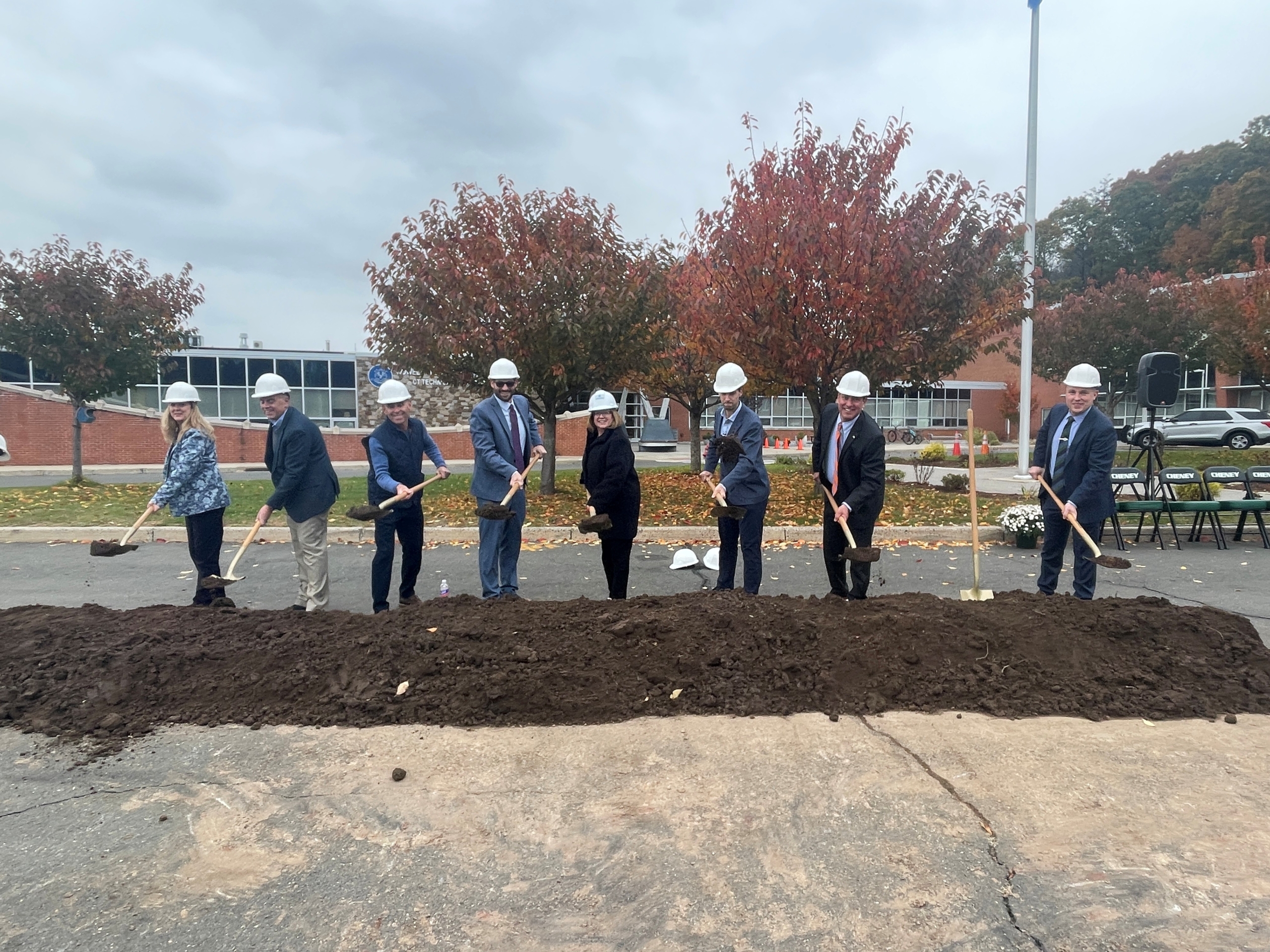
From left to right: CTECS Executive Director Dr. Alice Pritchard; State Representative Jason Doucette; Dennis Schain, Town of Manchester; State Representative Geoff Luxenberg; DAS Commissioner Michelle Gilman; Verogy CEO Will Herchel; Connecticut Green Bank President and CEO Bryan Garcia; Howell Cheney Technical High School Principal David Batch
Seven projects to provide 4.6 megawatts of clean energy and nearly $6 million in lifetime energy cost savings
MANCHESTER, Conn. (October 29, 2025) – The Connecticut Technical Education and Career System (CTECS) and Connecticut Department of Administrative Services (DAS), along with partners the Connecticut Green Bank (Green Bank) and Verogy, today announced the start of construction of seven solar energy projects at technical high schools across the state.
When completed, the seven solar energy projects, including rooftop and carport installations, will collectively deliver 4.6 megawatts of clean, renewable energy to the schools. Additionally, CTECS will save nearly $6 million in energy costs over the lifetime of the panels while reducing carbon emissions by the equivalent of approximately 2,290 metric tons annually.
The projects will also incorporate a workforce development component, offering both classroom and on-site learning opportunities for students at each school where projects are underway.
CTECS Executive Director Dr. Alice Pritchard, DAS Commissioner Michelle Gilman, Connecticut Green Bank President and CEO Bryan Garcia, and Verogy CEO Will Herchel were joined by state and local officials and other project partners at a ceremonial groundbreaking event for a 756.8-kilowatt (kW) carport system serving Howell Cheney Technical High School in Manchester, one of the schools benefiting from solar.
“This solar project represents so much more than an investment in clean energy, it’s also an investment in our students by giving them exposure to technologies that are shaping the future of their industries,” said CTECS Executive Director Dr. Alice Pritchard. “At the same time, the energy savings generated by these systems allow us to redirect operational funds into other programmatic areas. It’s a model for how collaborative projects can advance our educational mission while supporting Connecticut’s energy goals.”
“This initiative is a great example of how Connecticut is leading the way in clean energy innovation and workforce development,” said DAS Commissioner Michelle Gilman. “By investing in solar power at our technical high schools, we’re not only reducing our carbon footprint — we’re also preparing the next generation of skilled workers, trained at these technical high schools, to thrive in a green economy.”
“We are incredibly honored to play a supporting role and invest in these projects alongside our partners at CTECS, DAS, and Verogy,” said Bryan Garcia, President and CEO of the Connecticut Green Bank. “Through our Solar Marketplace Assistance Program Plus (Solar MAP+), we help state agencies, municipalities, school districts, and affordable housing providers install solar and storage, making the benefits of these technologies more affordable and accessible through our no cost technical and financial assistance.”
“As a graduate of Wilcox Tech’s Electrical Program, I know how valuable hands-on technical education can be,” said Torre Babich, Project Manager at Verogy and a Wolcott native. “I started my journey in the electrical trade right here in Connecticut, earning my diploma and completing 2,000 hours of classroom training. Having supported the launch of the engineering phase of the CTECS solar projects, it’s incredibly rewarding to see them move forward, bringing clean energy to schools while offering students the same kind of real-world experience that launched my own career.”
In addition to the carport system serving Howell Cheney Technical High School, the other schools benefiting from the new solar energy systems include:
• W.F. Kaynor Technical High School (Waterbury) – 448.8 kW rooftop system
• A.I. Prince Technical High School (Hartford) – 170.5 kW rooftop system
• Eli Whitney Technical High School (Hamden) – 756.8 kW rooftop and carport systems
• Emmett O’Brien Technical High School (Ansonia) – 897.6 kW rooftop and carport systems
• Henry Abbott Technical High School (Danbury) – 616 kW carport system
• H.H. Ellis Technical High School (Danielson) – 959.2 kW roof and carport system
About the Connecticut Technical Education and Career System
Through exemplary trade and academic programming, the Connecticut Technical Education and Career System (CTECS) prepares high school students and adult learners to meet the skilled workforce needs of Connecticut employers. CTECS operates 17 diploma-granting technical high schools, one technical education center for grades 11 and 12 and adult learners, and two aviation maintenance technician training programs. CTECS serves approximately 11,500 full-time high school students in over 30 Career and Technical Education (CTE) programs. In addition, over 3,000 adult learners take part in day courses, and evening apprenticeship and extension courses. All CTECS academic and CTE curriculum are designed with relevant, 21st-century employability skills required by business and industry.
About the Connecticut Department of Administrative ServicesThe Connecticut Department of Administrative Services (DAS) provides timely and cost-effective services to state agencies, state employees, municipalities, private industry, and the public. DAS offers a diverse array of programs, encompassing statewide human resources, information technology, fleet vehicle services, building and construction, procurement, grants administration, and beyond.
About Verogy
West Hartford, Connecticut-based Verogy is a leading solar developer with unmatched experience advancing customized commercial, industrial, and utility-scale renewable energy projects. With a diversified portfolio of cutting-edge renewable energy projects and a robust, growing pipeline, Verogy is actively delivering solutions across more than 20 states. Since its founding, Verogy has supported projects in the production of over 200,000 MWH of renewable energy. From project financing to design and construction, Verogy delivers renewable energy solutions that help communities, businesses, and institutions achieve their sustainability goals. Learn more at https://www.verogy.com.